
For the Love of Daisy… How one little dog inspired a bigger conversation about love, loss and the animals we call family.

PHOTO CREDIT: Daisy/Daisy’s Legacy
If you’ve ever loved a pet, you understand.
Pets are not “just animals.” They become woven into our everyday lives, into our families, our stories…and into our very beings. They are present for the mundane moments we hardly notice and the memories we’ll treasure forever. They comfort us through heartbreak, make us laugh when we need it most…and somehow know when to be there for us before we even realize we need them.
And when they're gone, the love doesn't disappear.
Sometimes, it becomes something else entirely.
For Krasi Mircheva, that love was Daisy.
Daisy, a Cavalier King Charles Spaniel, was Krasi's service dog, constant companion and best friend for more than a decade. When Daisy developed a life-threatening heart condition, Krasi was determined to give her every chance she could. She sold her car to help pay for specialized heart surgery in London, and the surgery was successful. Daisy came home healthy and thriving.
She had been given a second chance.
Six months later, Daisy developed a heart arrhythmia. She was prescribed medication, but according to Krasi, a dispensing error resulted in Daisy receiving a different drug. Her health rapidly declined, and despite emergency efforts to save her, Daisy passed away days later.
The loss was devastating.
But in the days that followed, Krasi discovered something that didn't match the relationship she'd spent more than a decade living. Daisy had been family to her, but in the eyes of the law, she was largely property.
For Krasi, that realization became the beginning of something bigger.
She founded Daisy's Legacy, a nonprofit dedicated to animal welfare, pet safety and advocacy, with a mission rooted in the little dog who had changed her life.
Then came Roxie.
A rescue dog who arrived severely underweight, traumatized and terrified of human touch, Roxie gave Krasi another window into the gaps that still exist in protecting companion animals…from neglect and abuse to irresponsible breeding and abandonment.
Two dogs. Two very different stories. And one growing belief that we can do better for the animals who share our lives.
Together, Daisy's and Roxie's stories inspired Daisy's Law – Companion Animal Family Member Act, a proposed legislative initiative designed to strengthen protections for companion animals, and begin changing the way they are recognized under the law.
At its heart is a question that feels surprisingly simple:
If our animals are family to us, should the law recognize that they are more than property?
We sat down with Krasi to talk about Daisy, the heartbreak that changed everything, why she believes our laws haven't caught up with the way we love our animals, and the legacy she's determined to create in Daisy's name.

PHOTO CREDIT: Krasi Mircheva/Daisy’s Legacy
Daisy's story is the heart behind this movement. How did losing her change not only your life, but also your perspective on the legal protections—or lack thereof—for companion animals?
Daisy wasn't just my dog…she was my family, my service dog, and my best friend for more than ten years. She helped me through some of the most difficult moments of my life. In 2023, Daisy underwent a specialized mitral valve repair at the Royal Veterinary College in London, UK, a procedure that was not yet available in the United States. She recovered beautifully and was given a second chance at life.
That chance was taken away by a preventable pharmacy error. Daisy was prescribed one medication but was dispensed another. Despite emergency treatment, she passed away.
In the aftermath, I assumed the legal system would recognize the magnitude of what had happened. Instead, I learned that under the law, Daisy was treated primarily as property, even though she was my service dog, and an irreplaceable member of my family. The legal remedies focused largely on her economic value, rather than recognizing the devastating loss our family experienced, or the preventable negligence that caused her death.
That realization changed everything for me. I founded Daisy's Legacy not only to rescue dogs in need, but also to advocate for stronger legal protections, so that no other family has to experience the same heartbreak. Daisy deserved better, and so do the millions of families who love their companion animals.
For readers who may be hearing about it for the first time, what is Daisy's Law, and why do you believe these legislative changes are so urgently needed?
Daisy's Law is a proposed legislative initiative that seeks to modernize how companion animals are treated under the law. Our goal is simple: our laws should reflect what society already knows…that companion animals are sentient beings who feel pain, fear, comfort, and love, and that they are family members to millions of Americans.
The proposal includes recognizing companion animals as sentient beings, rather than ordinary property, allowing courts to better recognize their unique value and welfare interests, strengthening protections against abuse and neglect, improving accountability when negligence causes serious harm, increasing breeder oversight, and modernizing legal standards that have remained largely unchanged for generations.
Many European countries have already recognized animals as sentient beings in their legal systems. It is time for the United States to begin having that same conversation.
These changes are urgently needed, because every day families lose beloved animals through preventable negligence, cruelty, irresponsible breeding, or inadequate legal protections, yet the law often fails to reflect the profound bond between people and their companion animals.
Your proposal addresses issues ranging from recognizing pets as sentient beings to breeder oversight, stronger accountability, and better protections in abuse and neglect cases. Which of these reforms do you believe would have the greatest impact, and why?
Recognizing companion animals as sentient beings would be the foundation for every other reform.
The law shapes how society views and protects those within it. As long as companion animals are legally viewed primarily as property, many legal decisions begin from the wrong premise.
Recognizing their sentience would encourage courts and lawmakers to consider their welfare more thoughtfully, strengthen protections in abuse and neglect cases, support more meaningful accountability when negligence occurs, and better reflect the reality that these animals are living, feeling individuals, not replaceable objects.
At the same time, stronger breeder oversight and a comprehensive identification and traceability system are critical to preventing suffering before it begins. Every day, dogs are bred in backyards, or other unregulated settings, without proper health testing, veterinary care, socialization, or sanitary conditions. Many are sold through Facebook, Craigslist, online marketplaces, or informal sales, with little or no oversight or accountability.
When these dogs become sick, develop inherited genetic conditions, or are abandoned, they often end up in overcrowded shelters and rescue organizations. The breeders who profited from them are rarely identified, or held responsible. Without traceability, it becomes extremely difficult to identify where these animals came from, monitor breeding practices, or prevent repeat offenders from continuing to operate.
A modern traceability system using mandatory microchipping and registration would help to ensure that dogs can be tracked from breeder to owner, improve enforcement against irresponsible breeding practices, reduce illegal breeding operations, strengthen consumer protection, and create accountability throughout an animal's life.
Together, these reforms would help prevent countless animals from entering the shelter system in the first place, while improving their welfare throughout their lives.
What are the biggest misconceptions people have about the legal rights of companion animals, and what do you wish every pet owner understood?
Many people believe the law already protects pets the same way society values them. Unfortunately, that is often not true.
Most people are surprised to learn that if someone else's negligence kills their companion animal, the legal system may treat that loss similarly to damage to personal property. They are equally surprised to learn how limited legal remedies can be, even when the negligence is clear.
I want every pet owner to understand that our emotional relationship with our animals has evolved far beyond what many laws currently recognize. That is why legal reform matters…not only after tragedy occurs, but because stronger legal protections encourage greater responsibility, accountability, and prevention.
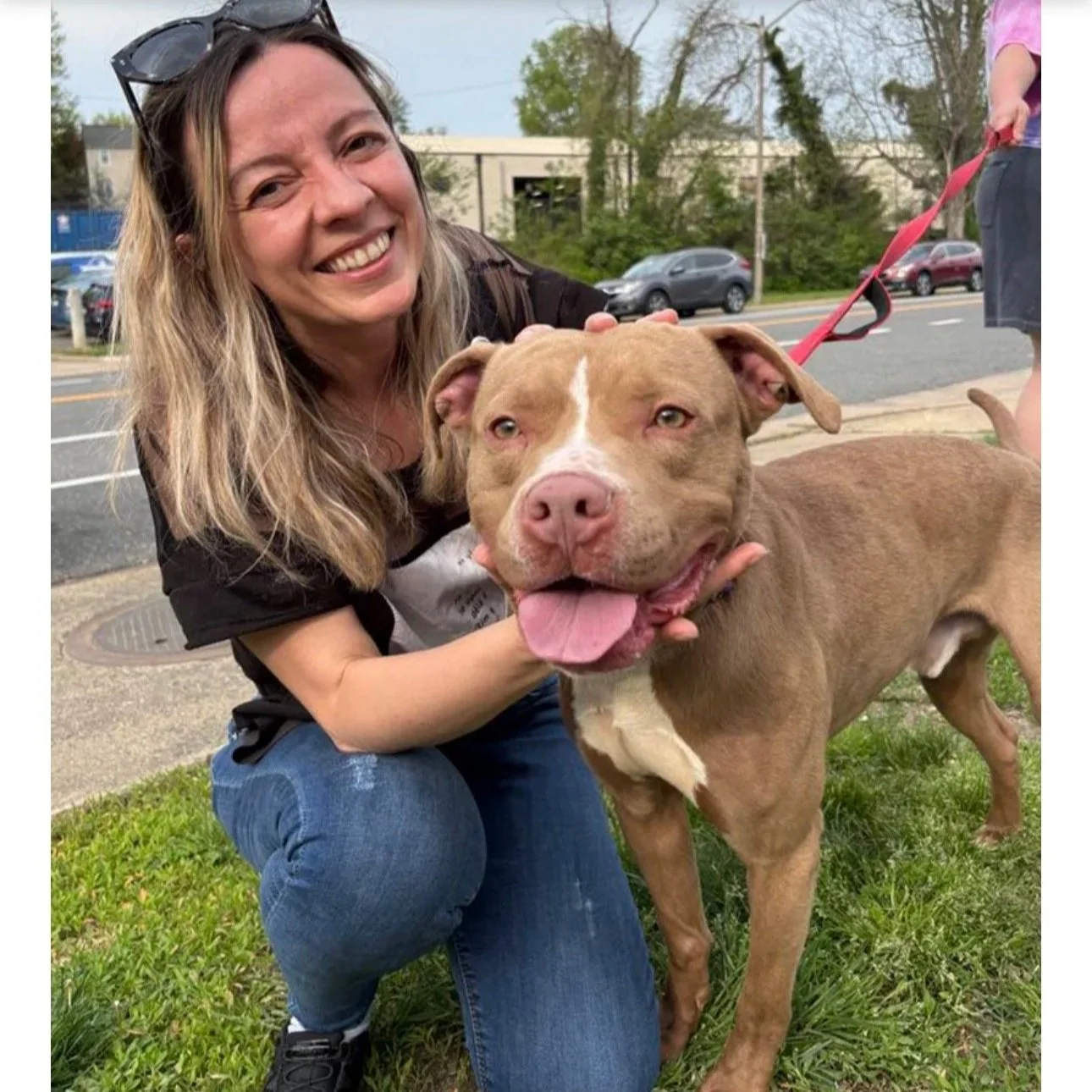
PHOTO CREDIT: Mira Mircheva/Daisy’s Legacy
Beyond Daisy's story, what larger conversation do you hope this legislation sparks about how we value and protect animals in our society?
Daisy's story is deeply personal, but this movement is much bigger than one dog.
I hope Daisy's Law starts a broader conversation about our evolving relationship with companion animals. Today, millions of families consider their dogs and cats to be members of the family. Veterinary medicine, behavioral science, and our understanding of animal cognition have advanced tremendously. Our laws should evolve alongside that knowledge.
This conversation is not about diminishing human rights. It is about recognizing scientific understanding, strengthening responsible ownership, encouraging accountability, and creating legal protections that better reflect modern society.
Ultimately, it asks a simple question: if we know animals think, feel, suffer, and form emotional bonds, shouldn't our laws acknowledge that reality?
What challenges have you faced in trying to move Daisy's Law forward, and what gives you hope that meaningful change is possible?
One of the biggest challenges is that changing long-standing legal frameworks takes time. Many people initially assume these laws already exist, because recognizing companion animals as family simply feels like common sense.
There are also understandable concerns about how legal reforms would affect existing systems. That's why education is such an important part of this effort. Daisy's Law is intended to encourage thoughtful, balanced modernization, not create unintended consequences.
What gives me hope is the overwhelming response from the public. Thousands of people have already signed our petition. We've heard from families across the country who have experienced similar losses and believed they were alone.
Support is also growing among veterinarians, animal welfare advocates, rescue organizations, and legislators who recognize that our laws should better reflect today's understanding of companion animals.
Meaningful change often begins with one conversation, one story, and one voice refusing to accept that the status quo is good enough.
What can our readers do today, whether through advocacy, education, or supporting your petition, to help move this mission forward, and create lasting protections for companion animals?
One of the easiest and most impactful ways to help is by signing and sharing our petition.
People can also educate themselves about current animal laws, contact their elected representatives, support reputable rescue organizations like Daisy's Legacy, advocate for responsible breeding and pet ownership, and help raise awareness that companion animals deserve stronger legal protections.
Real legislative change happens when enough people say that the current system no longer reflects our shared values.
Every signature, every conversation, and every shared story helps build momentum.
If Daisy's Legacy succeeds in bringing about these changes, what do you hope the future looks like for animals and the families who love them?
I hope we create a future where companion animals are legally recognized in a way that reflects the important role they play in our lives.
I hope families know that if negligence or cruelty harms their beloved companion, the legal system will take that harm seriously.
I hope stronger protections lead to better accountability, improved welfare standards, more responsible breeding practices, fewer preventable tragedies, and a future where fewer animals enter shelters because of irresponsible breeding and neglect.
Most of all, I hope Daisy's legacy becomes one of compassion, progress, and lasting change. Every person who signs the petition, shares Daisy's story, chooses adoption, or advocates for stronger protections helps carry her legacy forward and brings us one step closer to a better future for companion animals.
Is there anything else you would like readers to know?
Daisy's Law is not about assigning human rights to animals. It is about ensuring that our legal system recognizes what science and society already understand…that companion animals are sentient beings who experience pain, fear, comfort, and affection, and that they occupy a unique place within our families.
This movement belongs to everyone who has ever loved an animal. Whether your companion has been with you for fifteen years or fifteen days, they matter.
If Daisy's story can help prevent even one family from experiencing the heartbreak that mine did, then her legacy will continue to make a difference.
Daisy's story began with unimaginable loss, but I hope her legacy will be one of hope, compassion, and lasting change.
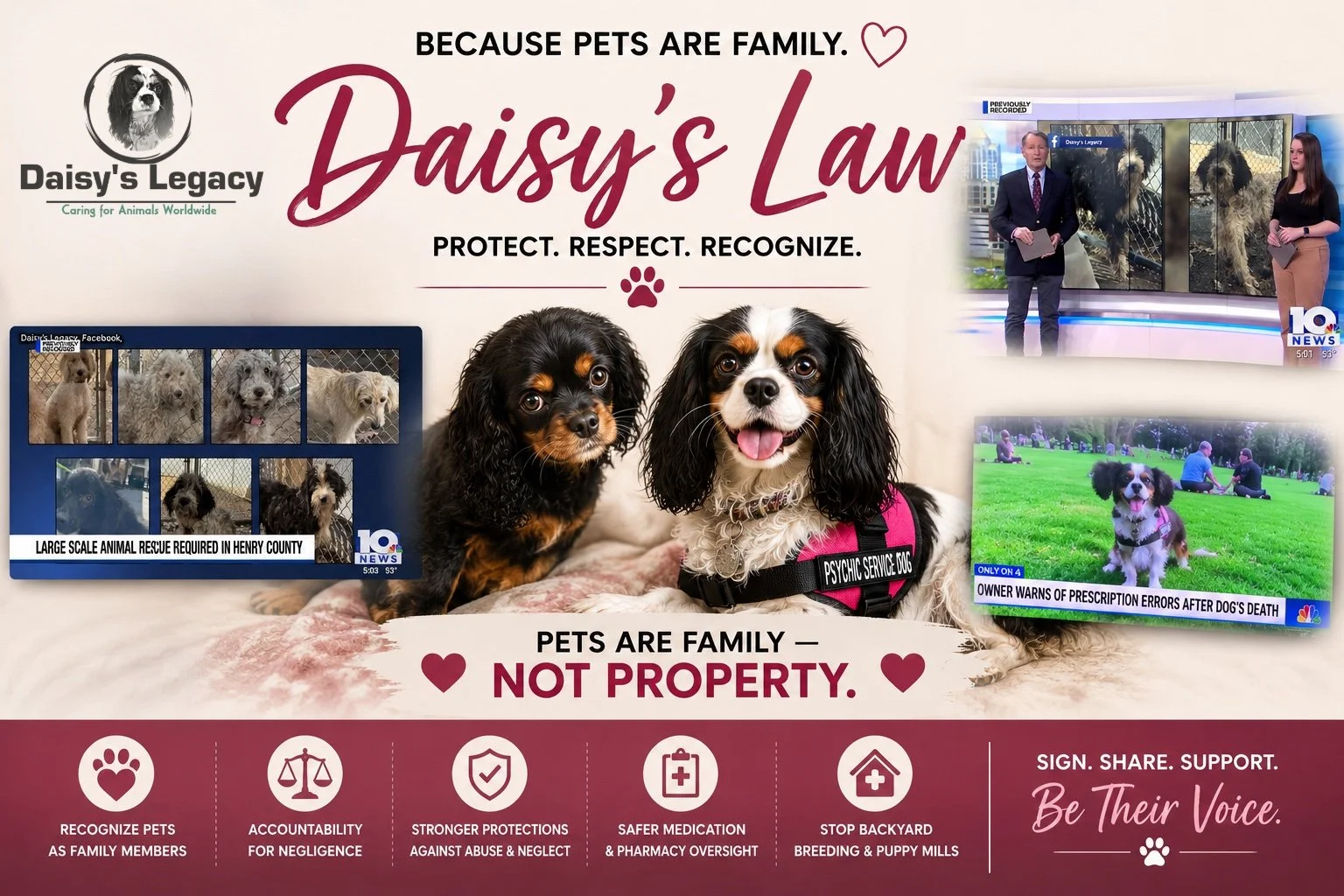
PHOTO CREDIT: Daisy’s Legacy
Maybe that's the thing about the animals we love. Their lives are never measured simply by the years we get with them. They leave pieces of themselves everywhere…in our routines, our memories, the way we love and, sometimes, in what we choose to do after they're gone.
Because for so many of us, they aren't pets. They're our furry family members. Our babies. Our children. We care for them, protect them, worry about them, rearrange our lives for them, and do everything we can to give them the happiest, healthiest life possible. They trust us completely, and in return, they give us a kind of love that asks for very little…and gives us so much.
And that means we have to do better for them.
When an animal is neglected, abused, or harmed through preventable negligence, or treated as though their life simply doesn't matter enough, we can't look the other way. The animals we bring into our families depend on us to be their voice, and the animals who haven't yet found a family need that voice just as much.
That doesn’t mean we have to agree on every issue, or vote for every piece of legislation. But it does mean we should be willing to have the conversation. To learn what protections exist…and where they fall short. To ask questions. To support responsible rescue, breeding and pet ownership. And to advocate for laws and policies that recognize animals for what they are: living, feeling beings who depend on us for their care and protection.
Daisy’s life was cut far too short. But love she brought into this world is still making an impact…through Roxie, through Daisy’s Legacy and through every person who signs this petition, shares her story, or decides that animals deserve better, because of everything they give us.
We can't protect them from everything. But we can love them with everything we have. Raise our voices when they need us. And continue fighting for a world where they’re treated with the kindness and compassion they deserve.
For the love of Daisy…and for every animal we have the privilege of loving and calling family…we can do better. And we should.
Please join me.
To learn more about Daisy’s Legacy, sign the petition or help support its mission: Visit Daisy’s Legacy.
